
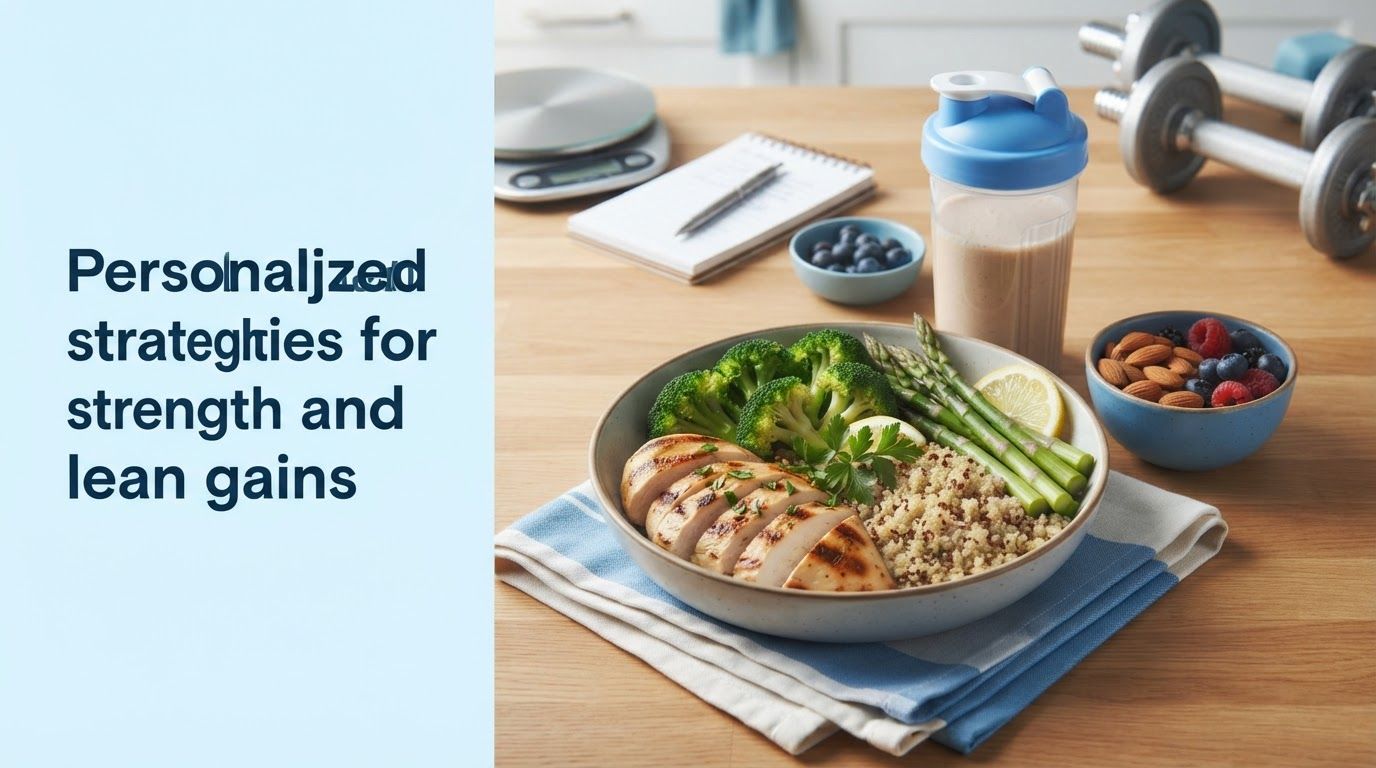
Building strength and lean muscle does not require chasing the biggest protein number you can find. Personalized protein strategies start with your weight, training, and goal: gaining muscle in a modest surplus calls for a different plan than protecting lean mass during a cut.
A common myth says that one perfect protein source, supplement, or meal schedule is essential for growth. The evidence points to a more practical approach: meet a suitable daily target, spread protein across several meals, train progressively, and adjust intake to your energy balance. More protein can help when intake is low, but extra servings have diminishing returns once the basics are covered.
Personalized protein strategies begin with your goal and daily intake
Protein provides amino acids used to build and repair tissues, including muscle. Resistance training gives your a reason to adapt; protein supplies material for that adaptation. Neither works in isolation. A high-protein diet cannot replace challenging training, and a well-designed program still needs enough food and protein to support recovery.
Recent reviews and the 2026 International Society of Sports Nutrition position stand put a practical muscle-building range at about 1.6,2.2 grams of protein per kilogram of weight per day when paired with resistance training. That is roughly 0.73,1.0 grams per pound per day. For many lifters, about 1.6 g/kg/day is a sensible starting point,not a guarantee of a particular result or a minimum everyone must hit exactly.
Quick answer: For strength and lean gains, start near 1.6 g/kg/day, distribute protein across roughly three or four meals of about 0.4,0.5 g/kg each, and adjust for your training and whether you are gaining or losing weight. A higher daily intake may be useful in some situations, especially during a calorie deficit, but more is not automatically better.
Use the range as a decision tool rather than a contest. If you are new to tracking and your meals are often low in protein, first build consistent protein-rich meals. If your current intake is already near the upper end, adding another shake may matter less than improving your training, sleep, or overall calorie and carbohydrate intake.
Calculate a starting target
Multiply your weight in kilograms by your chosen daily target. If you track in pounds, divide your weight by 2.2 to estimate kilograms, then multiply by 1.6,2.2. For example, a 176-pound lifter weighs about 80 kg; a starting point of 1.6 g/kg works out to about 128 g of protein per day. The upper end of 2.2 g/kg would be about 176 g.
These examples are planning arithmetic, not individualized prescriptions. Pick a target you can meet with ordinary meals, then evaluate your progress over several weeks alongside -weight trends, gym performance, appetite, and recovery. You do not need to treat daily fluctuations as a verdict on your plan.
Why the target is a range
Protein research continues to refine what “adequate” means across different ages, sexes, activity levels, and goals. A 2025 systematic review covered requirements across life stages and sexes, while a critical review from protein researchers described ongoing debate about optimal intake for muscle protein synthesis, muscle accretion, weight loss, and whether there is an upper intake level beyond which extra protein stops helping.
That uncertainty is a reason to avoid false precision, not a reason to ignore useful guidance. A 2026 review suggests benefits from protein and essential amino acids are strongest when daily intake is below roughly 1.6 g/kg or per-meal leucine is below about 2,3 g. Benefits tend to flatten as total intake rises above around 2.0 g/kg/day. Individual responses and study conditions vary, so those points describe a broad pattern rather than a hard biological switch.
Set protein per meal instead of saving it all for dinner
Daily total is the main anchor, but distribution makes that target easier to use. A workable approach is to eat protein across about three or four meals, aiming for roughly 0.4,0.5 g/kg per meal. For an 80 kg person, that is about 32,40 g at a meal. A snack or shake can fill a gap, but there is no requirement to eat on a rigid clock.
Muscle protein synthesis is the process of assembling new muscle proteins. Training stimulates the muscle-building response, and amino acids from food provide building blocks. A protein-rich meal supplies those amino acids; leucine, one of the essential amino acids, is often used as a marker of a meal’s ability to stimulate this response. The supplied evidence places a useful per-meal leucine reference around 2,3 g, but it is not necessary to calculate leucine for every plate.
Build a meal around a substantial protein portion
- Breakfast: eggs with Greek yogurt, cottage cheese, or a glass of milk; or oats paired with a protein-rich dairy or soy option.
- Lunch: chicken, fish, lean meat, tofu, tempeh, beans with a complementary protein, or another food you enjoy, alongside grains or potatoes and vegetables.
- Dinner: a palm-sized or larger serving of a protein food, adjusted to your target, plus a carbohydrate source and vegetables.
- Between meals: use yogurt, milk, cottage cheese, a sandwich filling, or a shake when food timing or appetite makes another full meal inconvenient.
Hand-size visuals can help when you do not weigh food, but they are rough estimates: palm size varies, and protein content differs across foods and cooking methods. Check labels or use a food database while learning portions, then rely on familiar servings if tracking becomes burdensome.
Meal frequency itself appears less important than total daily nutrition. Still, physically active people may benefit from spreading protein across the day rather than concentrating nearly all of it in one or two meals. A practical arrangement is breakfast, lunch, dinner, and an optional snack or shake,not a demand to eat every few hours.
Match protein and calories to a muscle-gain phase
Protein supports lean gains, but gaining muscle also requires a training stimulus and enough energy to recover and add tissue. If your weight is not rising and your training is progressing, a small calorie surplus may be appropriate. A 2026 narrative review suggests a moderate surplus of about 200,500 calories per day as a practical way to support lean-mass gain while limiting excess fat gain.
That range is a starting framework, not a promise that every calorie surplus will become muscle. A larger surplus can make weight rise faster without ensuring that the extra gain is lean tissue. Use the smallest increase that supports a steady trend in weight and training progress, and adjust based on what happens rather than assuming a calculator is exact.
Do not let protein crowd out training fuel
More protein is not a substitute for carbohydrates when your program relies on repeated hard sets and glycogen-dependent work. A 2026 review highlights roughly 3,6 g of carbohydrate per kilogram per day as a useful range for training performance and glycogen-dependent workload. The right level depends on the amount and intensity of training, total energy needs, food preferences, and how you perform.
For a lifter eating about 2,800 calories, for example, increasing protein without considering the rest of the diet could leave too little room for carbohydrates or fats that help make meals satisfying. This is not a fixed macro prescription: it illustrates why protein planning belongs inside a full-day eating pattern, rather than being treated as the only important number.
When progress stalls, assess the whole plan. Consider whether your training has enough progression, your calorie intake supports the chosen phase, meals are consistent, and recovery is adequate. If the daily protein target is already in a useful range, adding another serving may be less effective than correcting a chronic energy shortfall or an under-fueled training day.
Adjust protein for a calorie deficit and lean-mass retention
Cutting calories changes the objective. Instead of supporting weight gain, the priority is to lose fat while retaining as much lean mass, strength, and training quality as possible. The 2026 ISSN position stand describes resistance training plus sufficient protein as indispensable for minimizing lean-mass loss in a calorie deficit, regardless of diet style.
For general weight loss and physical activity, the position stand presents 1.2,1.6 g/kg/day as an appropriate daily range. For active people, it also recommends distributing protein across at least three protein-rich meals during sustained energy restriction. The muscle-building range of 1.6,2.2 g/kg/day remains relevant for resistance training, while the stand discusses 1.9,3.2 g/kg/day as a possible range to maximize lean-mass retention in lean, resistance-trained people in hypocaloric conditions.
These ranges are not contradictory: they address different populations and aims. The higher deficit-phase range is not automatically necessary for everyone dieting. A 2026 study of resistance-trained athletes found that baseline protein intake moderated the relationship between intake and fat-free-mass preservation. In other words, the potential value of adding protein may depend partly on what you were already eating.
Make the deficit manageable
Begin with a moderate, sustainable calorie reduction rather than trying to accelerate fat loss at any cost. Maintain resistance training, keep protein-rich meals in the plan, and monitor strength and -weight trends. If performance and recovery deteriorate sharply, review the size of the deficit, training stress, sleep, and carbohydrate availability as well as protein.
Keto, low-fat eating, intermittent fasting, and continuous calorie restriction can all be used for fat loss. The 2026 position stand emphasizes that diet style is not the key lever for protecting lean mass; adequate protein and resistance training are. Choose a structure that helps you adhere to the calorie target and meet your protein needs. If a particular eating window makes three protein-rich meals impractical, a different schedule may be a better fit.
Some lean, resistance-trained athletes may choose the higher protein end during a cut, but raising protein can also displace carbohydrates or fats and make the diet harder to sustain. The relevant question is not “What is the maximum I can eat?” but “What intake supports my goal without undermining training, food quality, or adherence?”
Choose protein sources for effectiveness, preference, and convenience
There is no single food that must appear in every muscle-building diet. A 2025 network meta-analysis found that milk-based proteins, whey, yogurt, casein, bovine colostrum, red meat, and mixed protein were all effective for muscle mass and strength outcomes. That finding supports flexibility: choose sources that fit your diet, budget, digestion, and daily routine.
A 2026 Bayesian network meta-analysis ranked whey highest for lean mass among common supplements used with resistance training, followed by milk and casein. This makes whey a strong default for lifters who want a convenient supplement, but rankings do not mean that whole foods or other effective protein sources are useless. A supplement can make a target easier to meet; it does not replace a balanced eating pattern or progressive training.
When a supplement is useful
Whey powder is compact, convenient, and easy to mix into a meal or snack. Milk, yogurt, eggs, fish, meat, soy foods, legumes, and mixed meals can also contribute meaningfully. If you avoid dairy, use other sources that work for you; a varied diet or a plant-based protein product can help fill a shortfall. Check the nutrition label and serving size rather than assuming all powders provide the same amount of protein.
A 2026 network meta-analysis reported an exploratory dose-response estimate of about 30,35 g per day of whey as associated with the largest lean--mass gains among common protein supplements combined with resistance training. Treat that as an estimate from the analysis, not a universal required dose or proof that everyone needs a daily whey serving. It is also not a direction to add 30,35 g on top of an already sufficient total without considering the rest of your diet.
Simple food swaps that raise protein without rebuilding your diet
- Swap a low-protein snack for Greek yogurt, cottage cheese, milk, or a protein-rich soy option.
- Add eggs, tofu, beans, tuna, chicken, or another familiar protein food to a meal that is mostly grains or vegetables.
- Use milk or a suitable fortified alternative in oats or smoothies, and pair it with a protein food if the meal still falls short.
- Prepare two or three protein options in advance,such as cooked meat or tofu, boiled eggs, and yogurt,so convenience does not default to a meal with little protein.
Food preference matters because the most effective plan is one you can maintain. If whey causes digestive discomfort or does not fit your diet, there are alternatives. If you enjoy a varied diet with adequate protein from meals, there is no need to buy a supplement just because it is popular.
Use timing as a practical tool, not a narrow anabolic window
Training creates a reason to pay attention to meals around exercise, but protein timing should not become a source of stress. A 2025/2026 evidence synthesis found that post-exercise protein improved fat-free mass and skeletal muscle mass. This supports eating protein after training as a useful option, particularly when it helps you reach your daily target.
It does not establish that a shake must be consumed immediately after the last set or that missing a short window wastes a workout. If you ate a protein-rich meal before training, your next meal can follow your ordinary schedule. If you trained after several hours without food, a protein-containing meal or snack afterward is a straightforward choice.
The same synthesis reported the strongest effects for nighttime protein on handgrip and leg-press strength in a network meta-analysis. That is an interesting finding, but it does not mean a bedtime shake is required for growth or that nighttime protein is better for everyone. Consider it an optional way to distribute intake if dinner is early or your daily target is otherwise difficult to reach.
A timing plan that fits a normal day
- Anchor your meals: choose three or four times when you can reliably eat a protein-rich meal or snack.
- Place one meal near training if convenient: before or after exercise is fine; choose the timing that suits digestion and your schedule.
- Fill genuine gaps: use a portable food or shake when a long workday, commute, or training session makes a meal difficult.
- Review the whole day: do not judge success by one meal. Consistent daily intake matters more than a perfect supplement schedule.
For people who train early, appetite may make a full meal beforehand uncomfortable. A lighter option can work, followed by a substantial meal later. For evening trainees, dinner can serve as the post-training meal. The plan should support training and fit life, not force every lifter into the same clock-based routine.
Keep supplements in perspective and recognize the limits of precision
Protein and essential amino acids sit at the base of a muscle-building supplement strategy because they supply material the uses to build tissue. A 2025 review of hypertrophy mechanisms describes other supplements,including creatine, HMB, omega-3s, citrulline or nitrates, and collagen,as secondary tools rather than primary drivers of muscle gain. They should not distract from protein adequacy, resistance training, and a suitable energy intake.
That hierarchy does not mean every listed supplement has the same evidence, purpose, or effect. It means that adding products is a poor solution to a plan missing consistent training or enough food. Before buying anything, ask whether a supplement addresses a real gap in your routine, whether the expected benefit matches your goal, and whether it is worth the cost and effort.
Protein targets also have limits as a planning tool. Body-weight formulas are convenient, but they do not account for every difference in composition, health, training history, appetite, or life stage. The 2025 research syntheses emphasize that requirements remain an active area of study across sexes and ages. A 2025 study in older women, for example, found that higher habitual protein intake was positively associated with changes in skeletal muscle mass during resistance training. That supports considering baseline intake and population,not assuming one finding applies identically to every lifter.
For healthy adults pursuing building goals, the ranges in this guide offer practical starting points rather than medical advice. People with a health condition that affects protein needs, or who have been advised to limit protein, should work with a qualified clinician or registered dietitian before making a major change. This is especially important if training, dieting, or supplements are being added to a medically managed plan.
Turn the numbers into a repeatable weekly plan
A useful protein strategy is specific enough to follow and flexible enough to survive a busy week. Set the daily target, identify your dependable meals, and decide what you will do when a meal is missed. Then reassess the plan against the goal: muscle gain, maintenance, or fat loss with lean-mass retention.
A simple setup for a gaining phase
- Choose a daily protein target within about 1.6,2.2 g/kg, starting near 1.6 g/kg if that is a clear improvement over your current intake.
- Divide that amount across three or four meals; aim around 0.4,0.5 g/kg at each meal when practical.
- Use a modest calorie surplus, with roughly 200,500 additional calories per day as a review-supported practical range, and track your -weight trend and gym performance.
- Keep enough carbohydrate in the diet to support your actual training workload; roughly 3,6 g/kg/day is a review-highlighted range to consider, not a mandatory target for every athlete.
A simple setup for a cut
- Maintain resistance training and choose an appropriate calorie deficit rather than relying on protein alone to preserve muscle.
- Use at least three protein-rich meals during sustained energy restriction, as recommended for active people in the 2026 position stand.
- Consider the general weight-loss range of 1.2,1.6 g/kg/day, or a higher approach when your resistance training, leanness, and circumstances make it suitable.
- Monitor strength, recovery, and adherence. If the plan is difficult to maintain, adjust meal choices and the deficit before assuming that still more protein is the answer.
Meal prep does not have to mean cooking every meal in advance. Cook a batch of one or two versatile proteins, keep convenient options available, and pair them with easy carbohydrates and vegetables. A prepared protein can become a rice bowl, sandwich, salad, or quick dinner without changing the core strategy.
For lifters who dislike tracking, build a repeatable pattern: include a meaningful protein food at each main meal, use a snack when needed, and review whether weight and training are moving toward the intended outcome. For lifters who enjoy tracking, use a food log temporarily to understand portions and identify gaps. Both approaches can work; the best one is the least complicated method that gives you useful feedback.
What to remember about protein for lean gains
Personalized protein strategies are built from three decisions: how much you need across the day, how to distribute it across meals, and whether your current phase is focused on gaining muscle or retaining it during a deficit. Start with a supported range, make protein-rich meals convenient, and let training performance and progress guide adjustments. You do not need a perfect supplement or exact eating schedule to make a solid plan.
For many resistance-trained adults, about 1.6 g/kg/day is a practical starting point, with roughly 1.6,2.2 g/kg/day available as a broader muscle-building range. Spread intake across three or four meals, use whey or other convenient sources when they help, and keep calories and carbohydrates aligned with your workload. Build consistency first; then refine the details that genuinely improve your strength, recovery, and lean-gain progress.

No comments:
Post a Comment